Friday, 14 September 2012

Curatorial Corner - 14th September 2012

The Harry Collection

Items in store ready for cataloguing
In our last Events Blog we mentioned the Harry Collection - a fantastic new donation of objects and archive material that came to the Museum in late 2011.  The donation will displayed at this years Railway Festival, but for those of you who cannot make it to STEAM, here is a bit more information on the donation of a lifetime.


The Harry Collection was bequeathed to STEAM after the death of Mrs Janet Harry in September 2011.  The items had belonged to her husband, Brian Harry, who had died six years earlier.  It was clear that Mr Harry was a prolific collector and had an eye for historically important material.  Mr Harry had collected these pieces for many years and the wealth of the items that were transferred to STEAM was substantial.  Amongst the collection (that was collected on a snowy December morning!) are nine locomotive nameplates, 72 locomotive numberplates, over 150 cast iron signs, 15 locomotive tender plates, eight signal box nameboards, 40,000 photographs, and a vast range of archive material.  Other objects include silverware, signalling instruments, a clock, oil cans, lamps, a bench...and much much more!

Malmesbury Railway map from the 1870s
on display at the Festival
The nameplates and numberplates are from some iconic locomotive classes, including Castles and Kings, and Stars and Manors.  There are also some early numbers, such as Nos 15, 77, 90 and 96.  The majority of the nameplates in the Harry Collection have a corresponding numberplate, and in the case of Baydon Manor we have the smoke box plate a well.  This must be the envy of many railway collectors around the World!

The archive material that makes up the Harry Collection has also been surprisingly important.  Among the items are a number of large ledgers that detail the costs and components of locomotives and rolling stock built in the mid and late 1800s.  The ledgers are really quite insightful and are going to be of huge value to historians and railway enthusiasts.   Also included in the collection are several staff registers.  The majority are from Swindon Works and list the names of foremen and staff from the Drawing Office.  A Drawing Office staff register from the early 1900s lists the name of F.W Hawksworth who went on to become the GWR’s last Chief Mechanical Engineer in 1941.  

Volunteers working on some of the
40,000 photographs
The Curatorial department are currently sorting and cataloguing the items in the collection, and are still finding some surprises.  Whilst sorting some Rule Book appendices the Museum’s Collection Officer, Elaine Arthurs, found a folded up drawing.  When she unfolded it she instantly recognised a signature that was signed at the top of the drawing; it was that of Isambard Kingdom Brunel!  The drawing is a colour wash plan of the Birmingham Tunnel on the Birmingham and Oxford Junction Railway.  It is dated 1856, and would have been some of the last work Brunel took part in before his death three years later.

There is still a huge amount of work to do on the Harry Collection.  The Museum's staff and volunteers have been busy beavering away cleaning, sorting, identifying, cataloguing and storing the material.  The collection of the 40,000 photographs will keep the Library and Archive volunteers busy for many months to come, but once fully catalogued it will be a valuable resource.

For more information on the Harry Collection please contact the Curatorial Department on 01793 466607 / 466608 or email steamlibrary@swindon.gov.uk

Thursday, 16 August 2012

Events Diary - Railway Festival News


Swindon Railway Festival, 15th - 16th September 2012

Ian Surtees, Commercial Manager, gives an update on the forthcoming Railway Festival.
 
With only four weeks to go before STEAM’s Swindon Railway Festival, plans are shaping up nicely for the Hornby Magazine sponsored model railway show.

Twenty top notch model rail layouts are heading to the home of the GWR with a couple making their first public appearances. Only the best GWR / BR(W) layouts make it into the festival so visitors are guaranteed the finest railway modelling experience during visit! The Museum is also pleased to welcome back Pete Waterman and the fantastic traction engine display provided by Hatch Steam Heritage.

On top of all these wonderful displays the Museum will also be exhibiting a new and unseen collection of artefacts that have recently been donated.  The Harry Collection is STEAM's largest ever donation and is made up of names plates, numberplates, signalbox nameboards, signs and 100s of other GWR related objects.
                                                                         

Western View Layout - courtesy of Model Rail
The following traders and exhibitors have already confirmed they’ll be at this year’s show:

Hornby Magazine
Cheltenham Model Centre
Box Steam Brewery
Picture Pride Displays
Squires Model & Craft Tools
Just Like The Real Thing
Hornby Hobbies
Bachmann Europe
County Rolling Stock
Aster Hobbies (UK)
Oakwood Press and Visuals
Kernow Model Rail Centre
The Signal Box
Coate Water Miniature Railway
Severn Valley Railway
Avon Valley Railway
Swindon & Cricklade Railway
6024 Preservation Society
6880 Betton Grange Society
West Somerset Railway
Ffestiniog and Welsh Highland Railways
Rodbourne Community History Group
Friends of the Swindon Railway Museum

Enthusiasts admiring a model layout  at the Festival in 2011
Confirmed Layouts

O Gauge
  • Lelant Saltings (Historical Broad Gauge Layout)
  • Bleadon (Col. Stephens Light Railway)
  • Pystyll-Graig-Ddu (Taff Vale)
  • Western View (Great Western Engine Shed and Station)
  • Aber Emyln (Welsh Valleys Railway)
  • Test Track (Bring your models to run on this layout)
  • Graig Wen **NEW LAYOUT** (Great Western Collery Screens)
  • Working 'O' Gauge Cranes
  • Nancleare Harbour (Narrow Gauge)
00 Gauge / EM / Scale 4
  • Hungerford (Scale model of Hungerford Station GWR)
  • Wales Rails Rain and Steam **NEW LAYOUT** (Diesel era)
  • Yardley
  • Bluchel Street (Diesel era)
  • Denroyd (London North Western)
  • Llawryglyn (Cambrian)
  • Corris 1930 (Narrow Gauge)
S Scale
  • Grove Ferry Junction (Col. Stephens Light Railway)
2mm Fine Scale
  • Union Pass (American Modern Railways)
  • Bodmin (Great Western Station)
  • Tucking Mill **NEW LAYOUT** (2mm layout)
Displays
  • Traction Engines (Hatch Steam Heritage)
  • Bill Slaymaker (Display of Rail Motors)
  • Mike Little (M&SWJ, Southern + Others Models)
  • Dennis Feltham (Display of mainline running steam locos)
There will also be lots of demonstrations taking place over the weekend, including demos in soldering, locomotive building, painting and wagon building.

Swindon Railway Festival 2012 Demonstrations
  • Paul Jones - Wagon Kit Building
  • Waverney Group - Scratch Building + DCC Hand Soldering
  • Chris Baston - Transfers and Kit Building
  • Warren Shepherd - Boiler Rolling
  • Andy Duncan - White Metal Soldering
  • Mike Gough - G Scale Demos
  • Chris Dunn - 4mm Loco Construction
  • Dave Walker / Liz Marsden - Large Scale Modelling + Painting & Lining
  • John Coulter - S Scale Modelling
  • Roger Manton - Weathering
  • Bob Brown - 3mm Scale Modelling
  • Richard Brown - Scratch Building 7mm Wagons
  • Derek Mundy - Signalling
  • Dave Baverstock - N Gauge Modelling
  • Fred Lewis - 7mm Modelling
  • John Taylor - Patterns for Panto-graph Milling
  • David and Sylvia White - (Slaters Plastikard) Inside Motion Crank Axles
  • Brian Tole - 7mm Building
This Festival is not to be missed!

Admission: £8.50 for adults; Seniors and Concessions £5.50; Family tickets £20.00 (two adults, one child) £24.00 (two adults, two children) and £27.00 (two adults, three children). Under three go free. Swindon Card discounts available

Friday, 3 August 2012

Curatorial Corner - 2nd August 2012

Sporting History comes to STEAM

The gates arrive at STEAM
With the Olympics in full flow this week it was with great pride that STEAM took possession of a pair of gates that came from the old GWR Sports Ground in Swindon.  


The site has not been in use since 2005, and is currently undergoing development by David Wilson Homes.  Staff at the Museum were concerned that the gates would be lost forever, and put the wheels in motion to transfer them to STEAM.  David Wilson Homes couldn't have been more helpful and within a couple of weeks of correspondence the gates were being dismantled and on their way to the Museum.


The gates bear the initials BRWRAA, which stands for British Railways Western Region Athletics Association.  The were made in Swindon Works in the 1950s.


The Sports Ground in 1935
The sports ground that the gates come from dates back to the early 1930s.  It provided for athletics, cricket, tennis, hockey, bowls, putting and rifle shooting.  The opening of a pavilion in 1935 further provided a skittle alley, recreation and games rooms and changing facilities for both men and women.  It was a showcase for GWR sporting excellence.


The Museum is also showing an exhibition called Track and Field which looks at the sporting prowess of Great Western employees.  It displays some fantastic images of GWR sports teams, as well as memorabilia such a trophies and fixture cards.  The exhibition is free with normal entry to STEAM and runs until the end of the year.


The gates will now undergo some restoration before they are displayed on the Museum site.


If you want to find out a little more on the gates, and their unique history, check out the latest Swindon Web TV video at the link below.


Swindon Web TV - arrival of sports ground gates at STEAM


Thursday, 24 May 2012

Curatorial Corner - 24th May 2012

The King and Queen come to Swindon


In this celebratory year of the Queen's Diamond Jubilee is was a real treat to find some royal material in our archive.  Tucked away in a box, the Curatorial team unearthed a file of paperwork relating to the visit of King George V and Queen Mary to Swindon in April 1924.


Confirmation of the King and Queen's
visit to Swindon
Our present Queen is busy visiting  lots of different towns and cities as she prepares for the upcoming Jubilee celebrations in June.  The work that goes into each royal visit must be huge, and the paperwork from 1924 reveals that the same was also true 88 years ago.


Part of the King and Queen's visit in 1924 involved a tour around the Great Western Railway's Swindon Works.  The paperwork is a detailed timeline of the organisation required behind the visit. Letters were sent to and from different departments.  It appears that the visit was kept quiet at first, then the first dregs of information were issued to the press.  It must have been an exciting, but nerve-racking exercise for the Great Western Railway.  They had to make sure the day ran smoothly, but also that the King and Queen were equally impressed by the facilities at the Works.


One memo notes that Swindon Works had 48 Union Jack flags in their stores, as well as over 11,000 yards of bunting.  This would be used to decorate the Works, the station and the GWR Medical Fund buildings.


The paperwork also looks at how the royal party would travel from the railway station to the Works, as well as how many of the press would be allowed in.  It is clear from one letter that they wanted only the best press representatives at the Works, such as Pathe, The Daily Sketch, The Daily Mail, The Daily Mail and The Daily Express.  Special passes would also be issued accordingly.


Extract from the GWR Board of Directors
 meeting minutes
 The visit by the King and Queen was a huge success.  The King got the opportunity to drive the locomotive Windsor Castle from the Works to the Station.  A fantastic day all round.  


The correspondence doesn't end there either.  The letters and memos continue into May 1924 with praise and thanks to the various employees who took part in the event.  One of the locomotive firemen who was showcasing an engine received £1 for his work, which in today's money is approximately £30.


The Great Western Railway's connection with royalty was a really important one.  Find out more about these connections by visiting the Museum's Royal Road exhibition.  The exhibition is on now until the end of the year and is free with normal admission.  Children can take part in a Royal Road activity trail as well.  Trails can be purchased from the main ticket desk or downloaded for free from www.swindon.gov.uk/steam


Happy Diamond Jubilee!


King George V and Queen Mary on the footplate of Windsor Castle
during their visit to Swindon Works, 28th April 1924


Sunday, 4 March 2012

Curatorial Corner - 4th March 2012

Nine go mad at STEAM

The Nine HND students, with their course leader Greg
A new exhibition has just opened at STEAM.  'Nine' showcases the work of 9 Swindon College HND photography students who over the past year have been photographing the Museum and its collections.

The photographs are an array of abstract and unusual images that transform the Museum objects into a different form.  They show incredible detail that the average visitor to STEAM will not see, or experience.

The students have curated the exhibiton themselves; taking the photographs, printing and hanging the final prints.  The exhibition preview night on Thursday 23rd February was a huge success and has caused a lot of interest over the past week.  The exhibition is open for a month (ending on 22nd March 2012) and is free with a normal entry ticket to the Museum.

Some of the images on display

Anthony Porter and his photographs

STEAM has been working with Swindon College, School of Art since 2009 and hopes to carry this partnership on in the future.  Some of the students have already had their work featured in STEAM's guidebook and all are currently finalising images for an online published photographic book.  The work with the college has transformed some very traditional objects and archive material into modern pieces of art, bringing the history of the Great Western Railway into the 21st Century.

Lee Davis and his photographs

Joe Cowley talks through his images with a member of the public
Photo courtesy of Justin Shurmer - jgshurmer@gmail.com

Photo courtesy of Justin Shurmer - jgshurmer@gmail.com

Photo courtesy of Justin Shurmer - jgshurmer@gmail.com


Wednesday, 25 January 2012

Curatorial Corner - 25th January 2012

Emergency!

The Curatorial team headed up to Birmingham last week to spend three days at the West Midlands Fire Service Acadamy.  The team were attending an Emergency Salvage course run by English Heritage.  The course was designed to provide pratical skills in saving important historical objects from museums and historic houses in the event of a fire or flood.

Flooding at the mock Museum

Day 1 involved being kitted up in firefighter uniforms.  A mock museum was set up inside the training firehouse and the hoses were turned on to simulate a flood - in this case gallons of water pouring through the roof!  The members on the course were tasked with trying to divert the flood using tarpauling, ladders, ropes and mops.  It was a hard task, but lots of really useful tips were gained.  Making a water shoot from two ladders and a piece of tarpauling is a simple way of diverting a huge flow of water!

STEAMs Curator, Felicity, (centre) kitted
up and ready to enter the mock Museum

Next came the slightly scary part.  The breathing apparatus.  Putting on the masks and oxygen cylinders felt very claustrophobic and heavy, but the experience was eye-opening.  Entering a smoke filled building was scary, but it gave a real understanding of what firefighters are faced with when entering a burning building.  Everyone on the course found it a great experience, but were glad to de-kit and have a lovely hot shower!


STEAMs Collections Officer, Elaine, making
 an inventory of salvaged objects


Day 2 was the day a real emergency was scheduled to happen at the mock Museum.  In the morning specific roles were given out and the team were briefed on what would unfold.  STEAM's Curator, Felicity, was going to be on the salvage team (tasked to enter the Museum and salvage objects) and Elaine, STEAM's Collections Officer, was to be the Documentation Officer.  There was also a recovery team, Press Officer and Quartermaster.  As the emergency unfolded a fire crew from a local station attended.  A 'fire' at the mock Museum had taken hold and the crew were quickly inside to put it out.  The fire crew were then given a list of items held in the mock Museum that were a priority to save.  The inside of the Museum was wet, black and smokey.  It was very difficult for the fire crew and salvage team to see which items were which.  However all the priority items were salvaged, in fact ALL the items were salvaged.  Once out of the Museum they were passed to the recovery team who documented each item and assessed their condition.  Wet items were put to dry, and dry items were safely boxed and sent to store.  The whole exercise took three hours to complete.  Everyone was thoroughly exhausted by 5pm.

Day 3 was a day of reflection.  The debrief in the morning allowed everyone to reflect on the previous days activities.  What went right, what went wrong - it was a definate learning curve.  But all agreed that the skills that would be taken back to respective museums and historic houses would be invaluable.  It also provided extra confidence if a situation arose.

To sum up, the course was great.  It was fun, informative and certainly challenging.  The Curatorial team at STEAM came away with new confidence and new skills.  If an emergency arose the Museum would be prepared - but lets just keep our fingers crossed it doesn't.

More Pictures Below... 

The Fire Crew turn up

The Fire Crew set up their equipment

The course team prepare for action!

Boxing up the objects ready for storage

Drying 'archive' material on a washing line


Wednesday, 19 October 2011

Curatorial Corner - 19th October 2011

Football, Steeplechases and Regattas

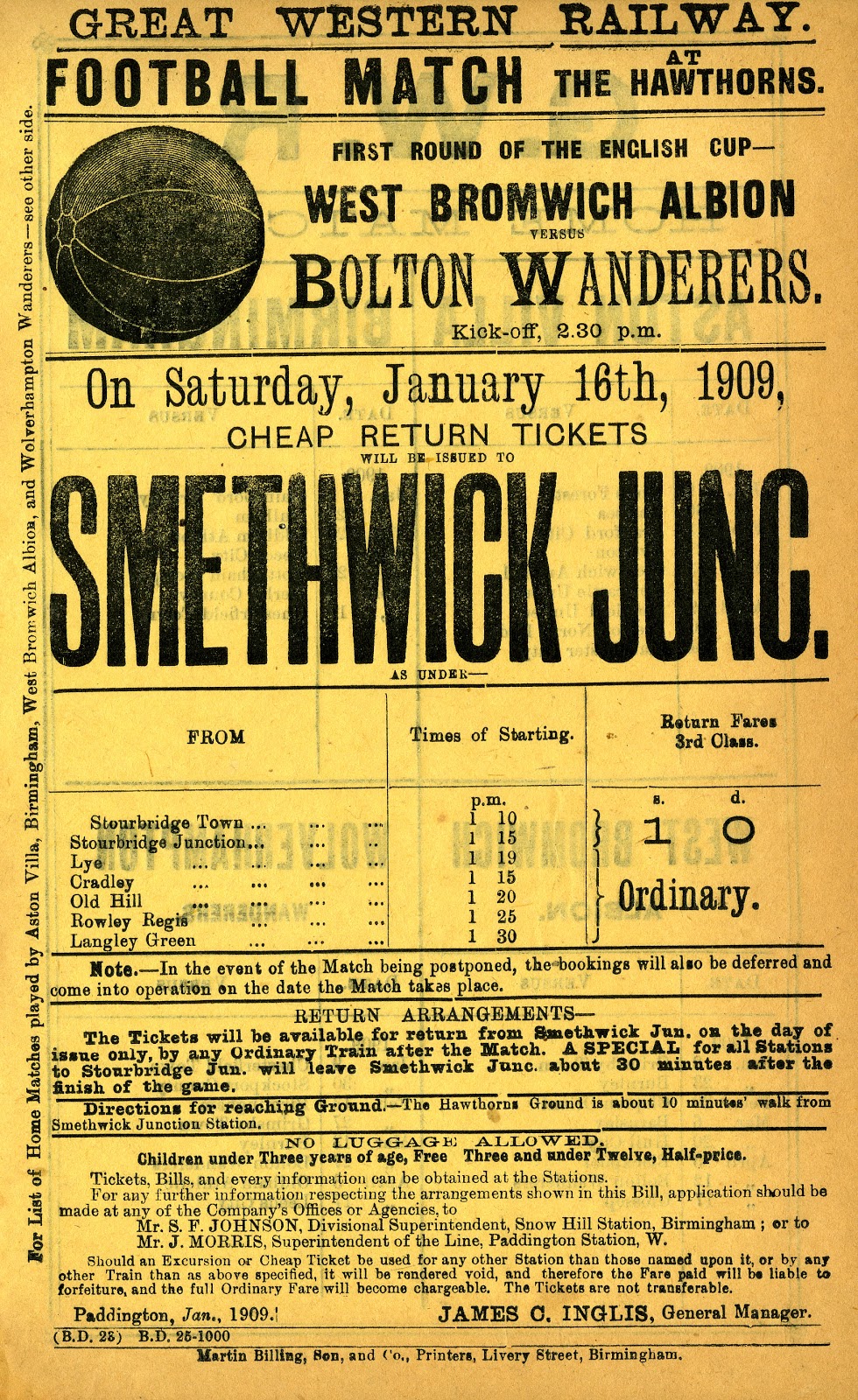
The Curatorial department at STEAM have been working on a conservation and re-storage project for over 100 fragile and historically important handbills.  The handbills all date from 1909 and highlight the very interesting social history of the Edwardian period.


January 1909 handbill

The brightly coloured handbills advertise excursion trips to various destinations, including Wales, London, Cheltenham and Windsor.  The handbills are a buzz of information giving details of prices and timings for the excursion trains.  There are also adverts informing passengers of what they might see at their destination.  In June 1909 an excursion from Wolverhampton to London was arranged for passengers to go and see the Africa and the East Missionary Exhibition and in March of the same year local services were put on for the North Warwickshire Hunt Steeplechases.  Adverts on the reverse of the handbills provide information on trips to Brittany on the steamer RMS Antelope, via the GWR Docks at Plymouth, or to Ireland via Fishguard on turbine steamers.

Some of the most interesting handbills advertise excursion trips to top league football matches.  Famous named clubs such as Aston Villa, West Bromwich and Reading appear on the handbills, but other clubs such as Glossop and Clapton Orient (later renamed Leyton Orient) also appear playing against these top flight teams.  Even 100 years ago football played an important part in people's lives and the GWR was making it possible for the fans to travel to matches.

The handbills are a great find and definately make for an interesting read!


Reverse of February 1909 handbill showing football fixtures


Wednesday, 14 September 2011

Curatorial Corner - 14th September 2011

Acton Garden Village

Steve Gregory, Library and Archive Volunteer at STEAM, was lucky enough to catalogue a new donation of photographs on the GWRs garden village at Acton.  In this Blog he shares his thoughts on this fantastic set of images.

STEAM has been lucky enough to receive a collection of 50 photographs tracing the development of the homes built by the GWR in its Acton Garden Village.  Donated in August, the images (all in black and white, but from a mixture of sources) start in 1924, and trace the growth of this development over almost 40 years. This collection will fascinate those who are interested in the history of the GWR and the ways in which it sought to look after its employees. Individual types of house available are clearly illustrated, along with aerial photographs showing the layout of the whole estate.
I was lucky enough to be asked to index the collection, and to add details of each image to the database which is used to help manage STEAM’s large collection of photographs, book & magazines. As I worked my way through the pictures, it struck me how much other information this small collection also contained. I had not realised, for instance, that there were companies providing aerial photography as a commercial service so soon after World War I, but here was the stamp of “Aero Films Ltd., Hendon NW9”, with individual negative numbers and a date of 1924. By 1928, the same firm was again taking a new set of photographs, so business must have good enough for it to survive the start of the depression.

A view of Acton Garden Village in 1935

By 1930, the houses are starting to show the individual touches added by the various tenants – roses growing on trellises or archways over garden paths. In 1935, communal areas have been grassed and planted with trees and shrubs, and even some hard-landscaping makes an appearance. 
Being so close to London and to the main lines, it would have been surprising if Acton Garden Village had escaped damage from bombing raids. Sure enough, a group of 12 photographs shows damage to West Acton School, and various houses with tiles blown from the roofs. There is even a close-up of what I assume (and hope, for the photographer’s sake) is an unexploded bomb of some kind. Judging by the garden fork lying nearby, it must have been a fair sized device, which makes the small amount of damage to the houses even more remarkable.
 After the war, there is a gap in the collection until 1961 when a picture from a local newspaper shows the estate as well established and well cared-for.
The collection shows a tremendous amount of social history and the changes to everyday life over the years ; 1930s pictures show a horse-drawn van and a delivery boy’s bike , while cars are parked outside some houses in 1961. The war-time shots show a very uncomfortable-looking pushchair, and a hand mangle to press  water out of items being washed at home, and barbed wire features on a number of fences.
Over the years, those who lived in the village have had a range of social activities.  An aerial shot from 1928 shows a cricket pitch, complete with well-kept wicket and pavilion, not far from the houses. A commercial photograph shows a trip to Ostende in Belgium organised by the Tenants’ Association - almost certainly in the late 1920s or 1930s, to judge by the clothes and the magnificent “Coach 7”, supplied by the British Travel Bureau of Ostende.  Another newspaper picture from 1961 shows the Acton Garden Village Sports Day Queen being ‘crowned’ by the Chairman of the Residents’ Association.  
The donation of 50 pictures, by a range of photographers, is a lovely little collection which adds still more interest by filling a previous gap in the STEAM Library and Archive. 

The donation of photographs also came with a range of paperwork relating to the history of the Village and a silver cup for the Village Allotment Association.

Friday, 29 July 2011

Curatorial Corner - 28th July 2011

New home for Photographic Collection


Upgraded Storage System
(System Stores Solutions Ltd)
The photographic collection at STEAM is one of our fastest growing collections.  At present we have over 40,000 prints, together with 1000s of slides, negatives and glass plates.  The images range from industrial scenes to locomotives and from official staff portraits to architecture.  It is a fascinating cross section illustrating the history of the Great Western Railway.

The photographic collection is housed in our archive and thanks to a generous grant from The Friends of Swindon Railway Museum the original storage system has been upgraded to allow the storage of another 20,000-30,000 photographs.

The Museum gets donated photographs almost every month and it is thanks to a dedicated team of volunteers that they get sorted, catalogued and filed.  It has taken 10 years to catalogue 40,000 photographs, and there are many years of work still ahead!

Our photographic collection can be viewed by appointment at the Museum, or you can access the collection online at http://www.steampicturelibrary.com/  Some of our amazing images can be seen below.


Evening Star, 1960


Women making nets in Swindon Works, c1930s


Sir Daniel Gooch


Friday, 15 July 2011

Events Diary - Railway Festival Update

Swindon Railway Festival 10th - 11th September

Ian Surtees, Commercial Manager, gives a further update on the forthcoming Railway Festival.


Swindon Works Tunnel Entrance in the 1930s

With nine weeks to go before the Swindon Railway Festival the Museum is just putting together the finishing touches to this years show.

To coincide with the 25th anniversary of the Swindon Works closure – STEAM are launching two new exclusive models at this year’s festival. Working with model specialists Dapol, we can confirm a limited edition run of the legendary Swindon designed and built Western Class ‘D1000 Western Enterprise’ will be available for pre-order at the show. This exciting news follows the recent announcement that STEAM have joined forces with market leader Bachmann to produce a low relief 00 gauge model of the Swindon Works tunnel entrance.  The tunnel is one of the most iconic features of Swindon Works and will be a great addition to any industrial model railway layout.  The new model will available to purchase at the Festival.

The following traders and exhibitors have already confirmed they’ll be at this year’s show and more traders are expected to follow soon.

  • Hornby Magazine
  • Picture Pride Displays
  • Squires Model & Craft Tools
  • Just Like The Real Thing
  • Hornby Hobbies
  • Bachmann Europe
  • Oakwood Press and Visuals
  • Kernow Model Rail Centre
  • The Signal Box
  • Severn Valley Railway
  • 6024 Preservation Society
  • 6880 Betton Grange Society
  • Friends of the Swindon Railway Museum

Confirmed Layouts

7mm (O Gauge)
East Wheal Dream
Knockley Gate
Dainton Bank
Happisburgh Goods
East Midlands Test Track (to showcase models)

4mm (OO Gauge)
Mythur Riverside
Llanryglyn – Cambrian period railway
West Cliffe
Cwmderi
Yardlea
  
S Scale
Kilbrandon
Aston Magna

2mm Fine Scale (N Gauge)
Highbury Colliery
Polpendra

There will also be lots of demonstations taking place over the weekend, includings demos in soldering, locomotive building, painting and wagon building.  And as confimed in April's Blog we will also be joined by Stanley Steam Cars, Box Steam Brewery, Hatch Steam Heritage and Roy Nash photography.

Prices for this year’s show will be held at the 2010 rates, but following demand we’ll be issuing weekender tickets for visitors wishing to join us for the whole weekend.

Admission: £8.50 for adults; Seniors and Concessions £5.50; Family tickets £24.00 (two adults, two children) and £27.00 (two adults, three children), Weekender Tickets: Adults £12.00, Seniors and Concessions £8.50. Under three go free. Swindon Card discounts available

View our previous Blog at http://steammuseum.blogspot.com/2011/04/events-diary-railway-festival-update.html
 

Wednesday, 29 June 2011

Curatorial Corner - 29th June 2011

In the Kitchen!

Back in April we were successful in obtaining a fabulous object at auction.  It arrived last week and we were thrilled with our purchase.  The item in question is a GWR Hotels copper saucepan.  It sounds very ordinary, but it is the first object of its kind that we have at STEAM.


We already have a large collection of cutlery, china, glass and silverware from the GWR Hotels and Refreshments Department.  All of these items are good quality, delicate, pieces that were used in front-of-house services for use by passengers in dining cars or hotels.  The copper saucepan is the complete opposite - plain, solid and very heavy (it weighs 3kg!).


The kitchens on carriages, in stations and hotels were an integral part of the GWR dining service provision.  It would have been a hive of activity with chefs preparing 5 course meals, sometimes in tiny confined spaces, for large amounts of people.  The copper saucepans were very heavy and would have been even heavier filled with water or vegetables.  It must have been a tough job working as a chef for the GWR, especially in a dimly lit kitchen carriage, swaying and lurching from station to station.  Not for the weak or faint hearted!


GWR Chef preparing food in a cramped kitchen carriage - note the saucepan on the left


Friday, 27 May 2011

Education News - 27th May 2011

STEAM Education Gets Top Marks for Educational Visits!

We’re fast approaching the end of another incredibly busy year with school visitors to STEAM. About 20,000 children a year come to experience our hands on interactive workshops, stepping back in time to the eras of Queen Victoria and the Home Front during WW2 (not at the same time!)

The Education Team is spending the summer planning and developing new activities to enthuse children, ready to launch at the beginning of the new academic year in September.

We’ve had great fun putting ourselves into the shoes of children and devising lots of new ways to use original objects, photographs and drama with schools. We can’t wait to try them -  if we grown ups didn’t stop laughing, then neither will the children!

We are enhancing our hugely popular We’ll Meet Again event for schools, which runs for two weeks every autumn and spring, based on feedback from our school customers.  Children will be up and moving when they come to immerse themselves in life in 1940! Jitterbug, anyone? Doubtless, there will be quite a few ‘Black Bottoms’! Regular visitors will spot new activities relating to wartime childhood and cracking codes. Ladies in a local care home are reminiscing about their own memories of being little girls in wartime, ready to share their stories with us (whilst spanning the eras by crocheting Victorian costume for children to use at the same time!)

However, the most exciting news for us and for our school visitors is that STEAM Education has just shown itself to be at the ‘top of the class’ for school educational visits by being the first heritage site in Wiltshire to be awarded the Learning Outside the Classroom Quality Badge. For us, this means that we have been nationally recognised by the Council for Learning Outside the Classroom for both the quality and safety of the experiences we offer school children and teachers. For schools and teachers, this means that they can cut red tape when planning to take children to our Museum and do not need to carry out their own risk or quality assessments.

We are absolutely delighted to be the first in Wiltshire, it is a huge coup for the Education team and all the staff here at STEAM and we look forward to welcoming even more children and young people from across the region to our wonderful Museum.